Friday, April 22, 2011

Ghara Bahuda (Odia Movie: 1973)


Ghara Bahuda (Odia Movie: 1973)


Director: Sona Mukherjee

Music Director: Akshaya Mohanty
Cast: Sujit, Sujata, Niranjan

Eka Eka Mane Mane

Singer: Nirmala Mishra
Lyricist:  Narasingha Mohapatra


Sunday, April 17, 2011

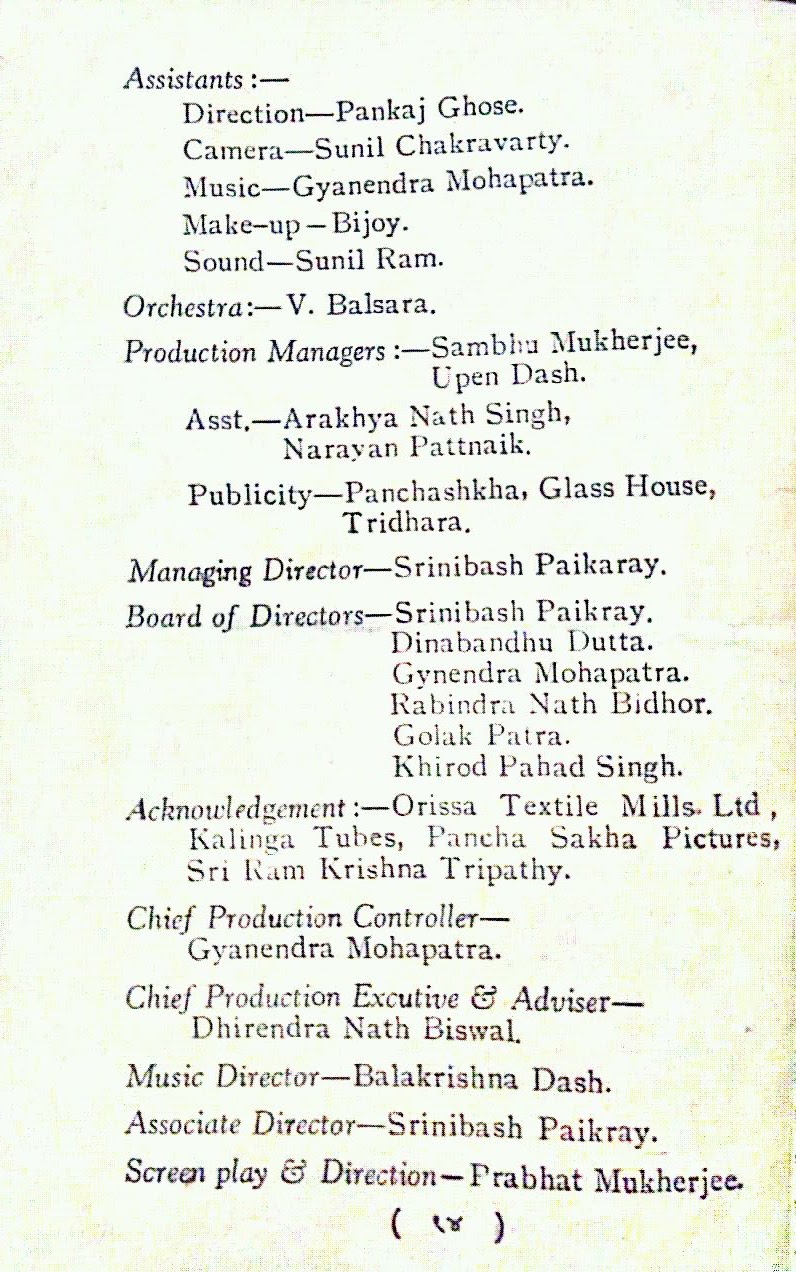
Manika Jodi (Odia Movie: 1963)


Manika Jodi (Odia Movie: 1963)

Director: Prabhat Mukherjee
Music Director: Balakrishna Das
Cast: Babi, Jatin Das, Ananta, Akshaya, Pratihari, Tima, Dhira, Sukhalata, Leela, Gitarani


Singer(s): Sikandar Alam & Sipra Bose
Lyricist:  Narayan Prasad Singh      


Jeeban Sathi (Odia Movie: 1963)


Jeeban Sathi (Odia Movie: 1963)


Director: Prabhat Mukherjee
Music Director: Balakrishna Das
Cast: Geetanjali, Meenati, Sarat Pujari, Sahu Samuel, Srinibasa


75 Years of Odia Cinema

Directorate of Film Festivals and 
Institute for Promotion and Research on Odisha Culture and Heritage present Odia Film Festival 2011 celebrating 75 years of Odia Cinema.
Special Attraction : Odia Cuisines, Handicrafts and Handlooms by Utkalika and Boyanika
Schedule (All Odia films carry English Subtitles)
16th April
12 noon : Jatra Jeevan Jeevan Yatra (Dir: Kapilas Bhuyan/50/Col) (Documentary)
1:30 pm : Klanta Aparahna (Dir: Manmohan Mahapatra/93/Col)
4:00 pm : Dhare Alua (Dir: Saghir Ahmed/140/Col)
7:15 pm : Indradhanura Chhai (Dir: Susant Misra/10/Col)


17th April
12 noon : Nilamadhab (Dir:Dilip Patnaik/53/Col) (Documentary)
1:30pm : Dhauli Express (Dir: Chittaranjan Tripathy/160/Col)
4:00 pm : Jianta Bhuta (Dir: Prashant Nanda/130 / Col)
7:30 pm : Adi Mimansa (Dir: A.K. Bir/130/Col)
...and many more interesting films.


Tuesday, February 15, 2011

Learning arts of adult life from novels


Talk with Chandrahas ChoudhuryThe Indian novelist and literary critic Chandrahas Choudhury will give a one-hour talk on the subject ‘Ten Ways To Change Your Life By Reading Novels’ on Saturday, the 19th of February, at 5pm at the Alliance Francaise, Lodhi Road.

In an age of self-help literature or the literature of ‘fact and analysis’, novels are sometimes thought of as dispensable books, to be read either to pass the time or perhaps to learn something about a country or a culture.
But what novels can most powerfully do for you, far more than any other kind of literature, is open up your own sense of yourself. More than any other form of writing, novels offer a vivid and complex education in all the arts of adult life, offering us ways to understand the range and depth of human choice, the possibilities and limitations Talk Ten Ways You Can Change Your Life By Reading Novels of various individual and communal ways of living, and the importance of the private and the sexual life of individuals to the health of society.
Novels teach us to respect language, showing us how better language leads to better thought. They allow us to develop a more complex understanding of time, by showing us the ways in which memory works in human beings, and how our decisions are always contingent on particular constellations of circumstances.
They demonstrate to us how doubt is just as useful a human virtue as certainty, and that the good life must respect both rationality and strong emotion. And by never offering any explicit advice, they in fact offer the best kind of help – the confidence that trusts the reader, as an adult, to make up his or her mind after considering all the evidence. The wisdom of the novel is not the wisdom of answers, but that of questions.
Choudhury will make his points with concrete examples from novels by a wide range of writers, including Orhan Pamuk, Irene Nemirovsky, Vikram Chandra, and Kazuo Ishiguro. For more information, please call us at 11 43 500 222 / 218 or send an email at culture@afdelhi.org.

Tuesday, November 02, 2010

Smith, Nietzsche, Shaw, Wells, Wilde, Orwell, Lucas, & Sri Aurobindo

Backtracking a little bit to the earlier posts concerning meditation, I came across these quotes from the Super-Guru, Sri Aurobindo. Have you ever heard of him? This Aurobindo Wiki entry is a good introduction, but needless to say, he seemed to know just about everything about everything, and wrote prolifically about it with such amazing acuity, insight, wisdom, and supreme knowledge, that one wonders whether one might possibly overcome his propensity for sentences that run-on in the extreme, in a prosaic style which could only be described as dated, beyond what any reasonable reader may be willing to continue concentrating upon, or even caring about, so that one (in this case the aforementioned reader) might eventually have to give up to the simple fact, arising from the intricate convolutions of his grammatical style and intensely profound and esoteric subject matter, that one has forgotten what he (being The Super-Guru Aurobindo) was talking about in the first place.
But bear with him and you'll find he really knew everything about everything. It's best to tackle his small, edited collections first, like: The Future Evolution of Man, and Bases of Yoga. What was I talking about again? Oh yes- Aurobindo"s observations on meditation...Dig how concise and amazing these bits from Bases of Yoga:[…]
He continues on (and on) in the generous and helpful manner that was his trademark. His teachings on the spiritual evolution of humankind are truly profound and essential. As you see from the above quote, he may very well have influenced George Lucas, and definitely others including Ram Dass, Sri Chinmoy, and Michael Murphy, founder of the Esalen Institute, and author of Golf in the Kingdom. POSTED BY RJK AT 12:40 PM 

H.G. Wells and Adam Smith. [This article is chapter 6 of Literature and the Economics of Liberty: Spontaneous Order in Culture.] Mises Daily: Friday, September 17, 2010 by Paul A. Cantor
[3] It is surprising how few critics have explored the economic dimension of The Invisible Man. The only one I have been able to find is Roslynn D. Haynes, who, in her H.G. Wells: Discoverer of the Future: The Influence of Science on His Thought (London: Macmillan, 1980), makes a passing comment on Griffin's "bourgeois mania for financial gain" (p. 203).
[4] The phrase "invisible hand" actually occurs four times in Wells's narrative (see pp. 76, 84, 85, and 90). Given the situation Wells was dealing with, this may have been inevitable, but it might be a covert reference to what is after all Adam Smith's most famous phrase. That Wells was familiar with Smith is evident from the fact that he mentions him in his A Modern Utopia (New York: C. Scribner's Sons, 1905), p. 85. The only critic I have found who mentions Smith in connection with The Invisible Man is Frank McConnell, The Science Fiction of H.G. Wells (New York: Oxford University Press, 1981), p. 114, but he is simply making a general point about the nineteenth-century novel "as capitalist fable." A precedent for using invisibility to symbolize the power of capitalism can be found in Richard Wagner's opera Das Rheingold. There the villain Alberich uses the magic of the Tarn-helm to make himself invisible and tyrannize over his fellow dwarves in Nibelheim, forcing them to amass treasure for him. Alberich thus becomes a symbol of the capitalist boss enslaving and exploiting the working class. That this interpretation of Wagner was circulating in Wells's England is evident from George Bernard Shaw's The Perfect Wagnerite, first published in 1898. [...]
[80] See Norman and Jeanne MacKenzie, Life, Illustration 12 (discussed on p. 63), for a remarkable cartoon Wells drew when he was twenty of himself "meditating on his future," which includes placards proclaiming: "How I Could Save The Nation" and "Wells's Design for a New Framework for Society."
[81] I analyze these developments in the specific case of Oscar Wilde in "Man of Soul," pp. 74–93. For the connection between Wilde and Wells, see McConnell, Science Fiction, pp. 42–43.
[82] See Haynes, Wells, p. 83. That is why Wells defines his samurai in A Modern Utopia as an order of "voluntary noblemen" (p. 121). Wells stresses the openness of his aristocratic order, and yet eventually he comes around to admitting that the samurai will become "something of a hereditary class" (p. 299). This is just one more sign that Wells's socialism would take us out of capitalism only to return us to medieval conditions.
[83] On Nietzsche and Wells, see Sutherland's "Introduction" in Luke, ed., Invisible Man, p. xxv, Carey, Intellectuals, p. 140, Bergonzi, Wells, pp. 9–12, 153, Vallentin, Wells, p. 124, John Reed, The Natural History of H.G. Wells (Athens: Ohio University Press, 1982), pp. 238–39, and John Batchelor, H.G. Wells (Cambridge, U.K.: Cambridge University Press, 1985), p. 5. In In the Days of the Comet, Wells's narrator, who in many respects is an autobiographical figure, proclaims: "I'm a disciple of Nietzsche" (Seven Science Fiction Novels of H.G. Wells [New York: Dover, 1934], p. 909; bk. I, chap. 4, sec. 4).
[84] Wells's attraction to supermen as leaders of the common herd often gives a fascist cast to his socialism. Although Wells opposed National Socialism as it developed in Germany, the liberal socialist George Orwell detected affinities between Wells's vision of the perfect state and Hitler's: "Much of what Wells has imagined and worked for is physically there in Nazi Germany. The order, the planning, the State encouragement of science, the steel, the concrete, the aeroplanes, are all there." See "Wells, Hitler and the World State" in George Orwell, The Collected Essays, Journalism and Letters of George Orwell (London: Secker & Warburg, 1968), vol. 2, p. 143.

What is Unseen from Cafe Hayek by Don Boudreaux
Each American, as both consumer and producer, is connected to hundreds of millions of other persons across the nation and the globe in a web of commercial relationships so vast, intricate, and nuanced that it is impossible to trace out and quantify in detail how changes in one part of this web affect other parts of the web.
Moreover, changes within this global web of commercial relationships are incessant, with changes in consumers’ demands for imports being simply one among a gazillion changes that occur each year. […]
It bears repeating again and again: there is nothing economically special about international trade as compared to intranational trade – save, of course, for the sorry fact that politicians and rent-seeking producers find it easy to demagogue for their own greedy, narrow purposes.

Sunday, September 12, 2010

Agonda & Malta

The built-in MacBook camera simply isn’t very good, and for various reasons I’m not in the habit of traveling with a real camera. However, this will at least get you in the ballpark of what the view from this room looks like. The sea is a lot more beautiful than that right now, however. It’s sparkling with different shades of green and blue at vari... 
waves from Object-Oriented Philosophy by doctorzamalek (Graham Harman)
The waves were really crashing tonight, at least in a few places. Malta is better when it’s like that. 

There are many lovely beaches in South Goa - and Agonda is one of them. This evening, we drove there. Truly a beautiful place, with green hills bordering both sides. … However, today, we did not walk along the beach as we have always done. We ended up walking along an internal road, parallel to the beach - a road on which there were at least a hundred homes, just metres from the beach, a beach that tourists really enjoy staying on. The road was tarred for just a 200 yards or so, and for the rest, a couple of kilometres, it did not exist!
It took about half-an-hour to cover the entire length of the non-road - and it ended at a narrow bridge about 10 yards long. On the other side was the "main road." But the bridge was too narrow for cars - only scooters and motorcycles could cross. All along, I saw signs of POVERTY - so rare in Goa.
Now, think of what happens to the prices of Property right upon a beautiful beach if there is no road. Obviously, these prices would shoot if a road was built - and a new bridge installed. Within no time, poverty would vanish. This is, in reality, PRIME REAL ESTATE! [Antidote: For Liberal Governance Sauvik Chakraverti (Hardcover - Jan 2003)]